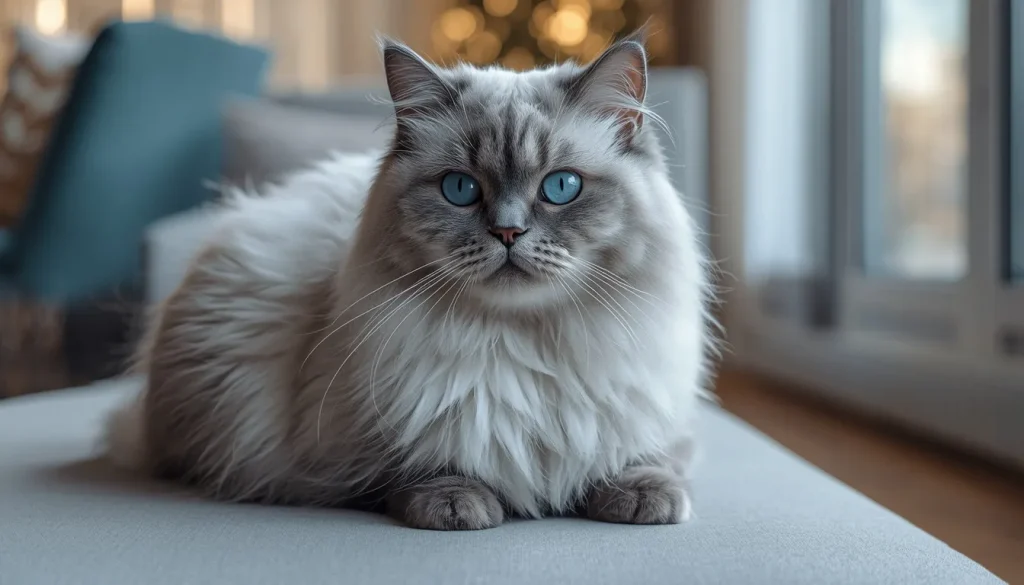
A grey Ragdoll cat is the kind of cat that tends to catch attention immediately. Its soft-looking coat, striking blue eyes, large size, and relaxed expression give it an elegant appearance, while its gentle personality makes it appealing to families and cat lovers alike.
But there is an interesting detail behind the term “grey Ragdoll.” In official Ragdoll breed terminology, what many people casually call grey is often referred to as blue. Blue Ragdolls have cool blue-gray coloring, especially on their points, which can give them the beautiful grey appearance people search for online.
Ragdolls are known as large, semi-longhaired cats with affectionate, easygoing temperaments. They mature slowly and can remain playful well into adulthood. The Cat Fanciers’ Association describes them as gentle, calm, sociable, and affectionate, while TICA notes their large size, blue eyes, relaxed temperament, and ability to get along well with children and other pets.
If you are thinking about bringing one home, appearance is only the beginning. A Ragdoll needs regular grooming, appropriate nutrition, daily enrichment, veterinary care, and plenty of companionship.
This complete guide explains what a grey Ragdoll cat looks like, what its personality is like, how big it can become, how to care for its coat, what to feed it, how to care for a kitten, and what you should consider before choosing one.
What Is a Grey Ragdoll Cat?
A grey Ragdoll cat is generally a Ragdoll with a blue toned coat that appears grey to the human eye.
The important distinction is that grey is usually a descriptive term rather than the formal Ragdoll color name. CFA lists blue among the recognized Ragdoll point colors, and TICA also uses blue as an official color while noting that it is commonly perceived as grey.
Ragdolls are a distinctive breed rather than simply a type of fluffy grey cat. They are known for their large bodies, semi-long coats, blue eyes, pointed coloration, and affectionate personalities.
Their body is normally lighter than the colored areas, or “points,” which are found around the face, ears, legs, and tail. Depending on the pattern, a Ragdoll may also have substantial white markings.
This is why two cats can both be described as grey Ragdolls while looking noticeably different.
One may have a blue colorpoint pattern, while another may be a blue mitted or blue bicolor Ragdoll.
Why Are Ragdolls Called Grey Instead of Blue?
The terminology can be confusing if you are researching Ragdoll cats for the first time.
In everyday conversation, people frequently use “grey” to describe cats with a cool blue-gray coat. In cat-breed terminology, however, blue is the recognized name for this diluted black-based color. TICA specifically explains that “blue” is commonly called grey or gray.
So if you search for a “grey Ragdoll cat,” you will often find information about blue Ragdolls.
This distinction is useful when looking for breeders, pedigrees, breed standards, or photographs. Searching for both “grey Ragdoll” and “blue Ragdoll” can give you a much broader and more accurate picture of the color.
It also helps prevent confusion between a genuine Ragdoll and another grey long-haired cat.
What Does a Grey Ragdoll Cat Look Like?
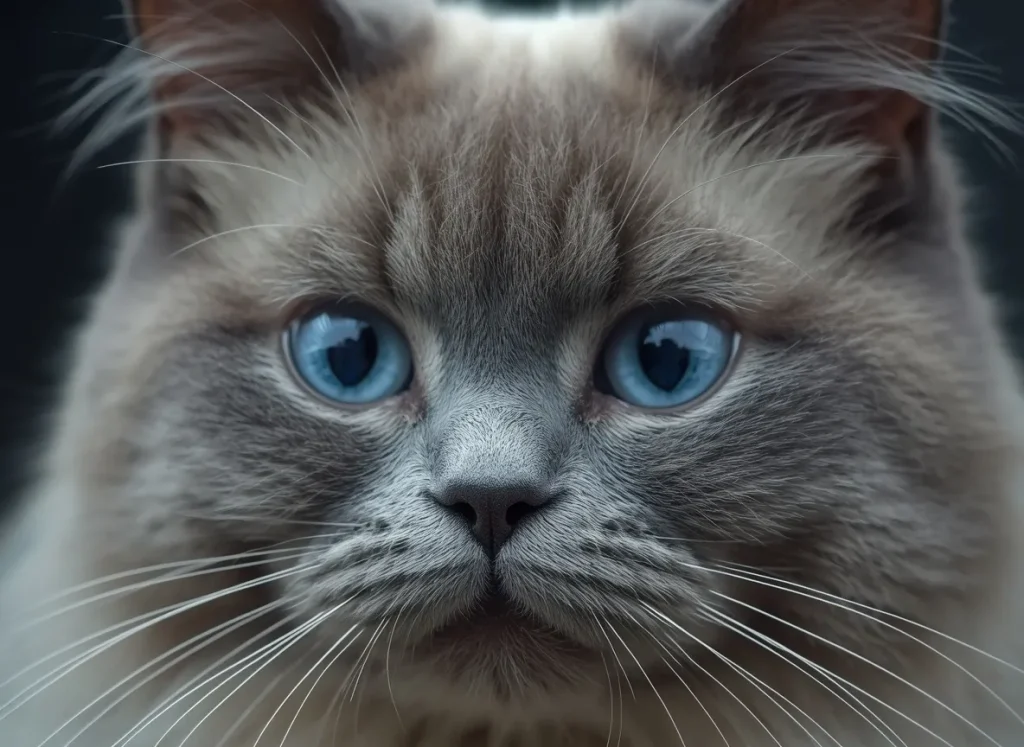
The appearance of a grey Ragdoll is one of its biggest attractions.
Ragdolls are large cats with a long, sturdy body, broad chest, substantial bone structure, and semi-long silky coat. They also have large blue eyes and a characteristic pointed pattern.
A grey or blue Ragdoll may have cool grey-blue coloring on the face, ears, legs, and tail, while the body remains considerably lighter.
Blue Eyes
One of the easiest characteristics to notice is the Ragdoll’s eye color.
Ragdolls are blue eyed pointed cats, and their vivid blue eyes provide a strong contrast against the cooler grey-blue points.
The combination of grey-blue coloring and blue eyes is a major reason these cats have such a distinctive appearance.
Semi Long Coat
The Ragdoll has a semi-long coat with a soft, silky texture. Compared with some other long-haired breeds, the coat is relatively easy to manage when maintained regularly. CFA describes the coat as consisting primarily of guard hairs with minimal woolly undercoat.
Even though the coat may be easier to maintain than you might expect, that does not mean grooming should be ignored.
Large Body
Ragdolls are among the larger domestic cat breeds.
TICA gives an adult female weight range of up to around 10–15 pounds and an adult male range of around 15–20 pounds, although individual cats can vary. The organization also notes that Ragdolls mature slowly and may not reach their full size until around four years of age.
Because of their size, owners should choose sturdy cat furniture, appropriately sized litter boxes, and comfortable beds.
Grey Ragdoll Cat Colors and Patterns
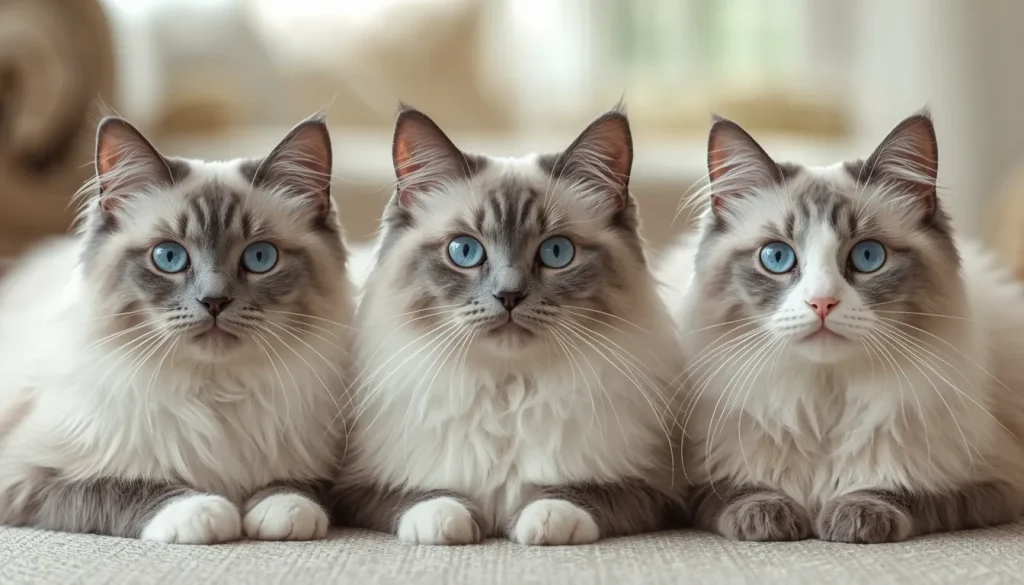
Not every grey-looking Ragdoll has exactly the same markings.
Ragdolls can have several patterns, including:
- Colorpoint
- Mitted
- Bicolor
They can also have variations such as lynx and tortie patterns depending on their color and genetics.
Grey or Blue Colorpoint Ragdoll
A colorpoint Ragdoll has darker points on the face, ears, legs, and tail without white markings on the body.
A blue colorpoint can have cool blue-gray points against a lighter body.
The contrast between the pale body and darker grey-blue points can become more noticeable as the cat matures.
Grey or Blue Mitted Ragdoll
A mitted Ragdoll has white markings on specific areas, including the paws. It can also have a white chin and belly stripe.
A blue mitted Ragdoll therefore combines grey-blue points with attractive white “mittens” and other white markings.
Grey or Blue Bicolor Ragdoll
Bicolor Ragdolls have more extensive white markings. One of their most recognizable features is the inverted white “V” on the face.
A blue bicolor Ragdoll can therefore look considerably lighter than a blue colorpoint cat.
The different patterns are one reason the phrase “grey Ragdoll” can describe cats with quite different appearances.
Grey Ragdoll Cat Personality
The personality of a grey Ragdoll cat is often just as appealing as its appearance.
Ragdolls are generally known for being affectionate, calm, social, and easygoing. CFA describes them as loving without being demanding, while TICA characterizes them as relaxed, happy, loving, and generally quiet.
That does not mean every Ragdoll behaves exactly the same way.
Each cat has an individual personality influenced by genetics, early socialization, environment, and experiences.
Some Ragdolls may be extremely cuddly, while others prefer sitting beside their owners rather than directly on their laps.
Many enjoy following their people around the house and being involved in everyday activities.
Are Grey Ragdoll Cats Affectionate?
Yes, Ragdolls are generally considered an affectionate breed.
They often enjoy human companionship and may choose to stay close to their owners.
Some Ragdolls will follow family members from one room to another, wait nearby while someone works, or settle down beside them during quiet time.
However, affection does not always mean constant lap sitting.
A cat may show affection by simply choosing to be near you.
Are Grey Ragdoll Cats Calm?
Ragdolls are generally considered calm and laid-back, but “calm” does not mean inactive.
Kittens and young adults can be energetic and playful. TICA specifically notes that young Ragdolls can be rambunctious even though adults tend to have an easygoing temperament.
Providing toys and opportunities for play is therefore important throughout the cat’s life.
Are Grey Ragdoll Cats Good Family Pets?
A Ragdoll can be an excellent family cat for the right household.
Their generally tolerant and social nature can make them suitable for families with children, provided that children understand how to interact respectfully with animals.
Children should learn to:
- Approach the cat calmly
- Avoid pulling its tail or fur
- Never disturb it while eating
- Give it space when it retreats
- Handle kittens gently
- Avoid chasing the cat
- Respect signs that the cat wants to be left alone
A cat should always have access to a quiet place where it can rest without being disturbed.
Can a Grey Ragdoll Cat Live With Other Pets?
Ragdolls can often adapt well to homes with other cats and dogs.
TICA describes the breed as generally tolerant of other animals, including dogs, and CFA also notes that Ragdolls can get along well with children and other animals.
However, the introduction process matters.
A new Ragdoll should not simply be placed face-to-face with an unfamiliar dog or cat.
Instead, introduce pets gradually.
Start by allowing them to become familiar with each other’s scent. Then move toward controlled visual contact and supervised interaction.
Each pet should have access to its own food, water, resting areas, and other important resources.
How Big Does a Grey Ragdoll Cat Get?
One of the most attractive features of a Ragdoll is its impressive size.
Adult males are generally larger than females. TICA lists males at around 15–20 pounds and females at up to approximately 10–15 pounds, while emphasizing that the breed grows slowly and may take several years to reach full size.
Weight alone should not be used to decide whether a cat is healthy.
A veterinarian can assess body condition by looking at factors such as muscle, ribs, spine, and overall body shape.
Because Ragdolls are large, their equipment should also be appropriately sized.
A tiny litter box may be uncomfortable for a full-grown Ragdoll, and a lightweight scratching post may not be stable enough.
How Long Does a Grey Ragdoll Cat Live?
Ragdoll lifespan varies from one individual to another.
TICA notes that many Ragdolls live into their mid-to-high teens, although longevity depends on factors such as genetics and care.
Owners can support their cat’s overall wellbeing through:
- Regular veterinary checkups
- A complete and balanced diet
- Healthy body condition
- Dental care
- Appropriate exercise
- Mental enrichment
- Safe indoor living
- Good grooming habits
No particular routine can guarantee a specific lifespan, but consistent preventive care can help support a cat’s long-term health.
Grey Ragdoll Cat Grooming
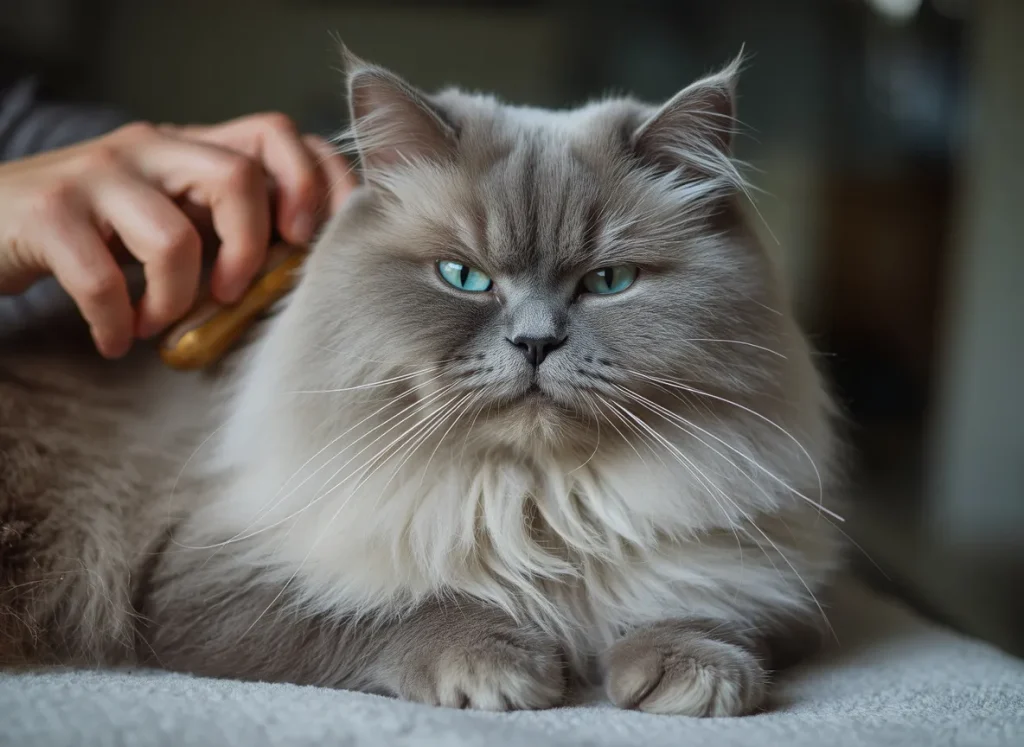
The beautiful coat of a Ragdoll needs regular attention.
Although Ragdolls generally have a silky coat and relatively little woolly undercoat, they can still develop tangles and mats if grooming is neglected.
A grooming routine can also help you notice changes in your cat’s skin or coat.
How Often Should You Brush a Grey Ragdoll?
The exact frequency depends on the individual cat.
Many owners find that brushing several times a week works well. Some cats may require more frequent grooming if their coat tangles easily.
Focus on areas where knots can develop, including:
- Around the neck
- Behind the ears
- Under the front legs
- Around the hind legs
- Along the belly
- Around the tail
Introduce brushing gradually if your kitten is not used to it.
Short, positive sessions can be easier for a young cat than trying to brush the entire coat at once.
Do Grey Ragdoll Cats Shed?
Yes. Ragdolls do shed.
TICA notes that shedding can be relatively limited compared with some other long-haired cats, with more shedding occurring seasonally.
The exact amount varies from cat to cat.
Regular brushing can help remove loose hair before it ends up on furniture and clothing.
It can also help prevent loose fur from becoming tangled with the rest of the coat.
Grey Ragdoll Cat Bathing
Most healthy cats do not need frequent baths simply because they have long or semi-long hair.
Ragdolls can generally maintain much of their own coat through normal grooming.
A bath may be appropriate in specific situations, such as when a cat becomes unusually dirty or a veterinarian recommends one.
If bathing is necessary, use a cat-safe shampoo and make the experience as calm as possible.
Never use human shampoo on a cat unless a veterinarian specifically recommends a particular product.
Grey Ragdoll Cat Diet and Nutrition
Good nutrition is essential for maintaining a healthy Ragdoll.
Because Ragdolls are large cats that mature slowly, their nutritional needs should be considered according to their life stage rather than simply their size.
Kittens generally need food formulated for growth, while adult cats need a complete and balanced diet appropriate for maintenance.
A veterinarian can help determine suitable portions based on your cat’s:
- Age
- Weight
- Activity level
- Body condition
- Health status
Avoid overfeeding simply because your Ragdoll is a large breed.
Extra weight can put unnecessary strain on a cat’s body and may contribute to health problems.
Fresh water should be available every day.
Exercise and Enrichment for a Grey Ragdoll
Ragdolls may have calm personalities, but they still need regular physical activity and mental stimulation.
TICA recommends interactive play and notes that toys, cat trees, scratching areas, and play sessions can help keep Ragdolls active and support healthy weight management.
Good enrichment options include:
- Feather wands
- Balls
- Interactive toys
- Puzzle feeders
- Scratching posts
- Cat trees
- Window perches
- Safe climbing areas
Interactive play also gives owners an opportunity to bond with their cats.
Several short play sessions can often be more practical than expecting a cat to entertain itself for hours.
How to Care for a Grey Ragdoll Kitten
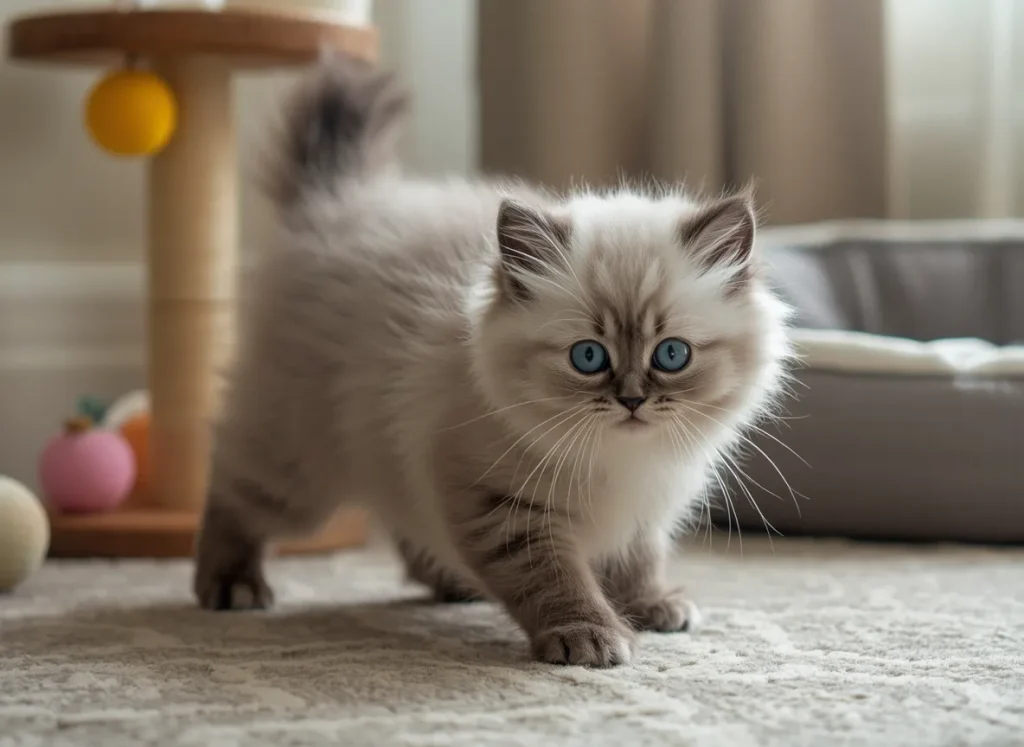
A grey Ragdoll kitten may look delicate and small, but it will eventually grow into a large adult cat.
Before bringing one home, prepare a quiet, safe area where the kitten can gradually adjust.
Your kitten should have:
- Age-appropriate food
- Fresh water
- A clean litter box
- A comfortable bed
- Safe toys
- A scratching surface
- Safe hiding spaces
- Appropriate veterinary care
Remove hazards such as exposed electrical cords, toxic plants, small objects, and areas where a kitten could become trapped.
Socializing a Ragdoll Kitten
Early experiences can have a major influence on how comfortable a kitten becomes around people and its environment.
Allow your kitten to experience new sounds, people, handling, and household activities gradually.
Do not force interaction if the kitten appears frightened.
Gentle handling and positive experiences can help build trust.
Grey Ragdoll Cat Health
Like every breed, Ragdolls can experience health problems.
Breed-specific health considerations are one reason responsible breeding and veterinary care are important.
If you are purchasing a Ragdoll kitten, ask the breeder about the health history of the parents and what genetic or veterinary screening has been performed.
A responsible breeder should be willing to discuss health information rather than focusing only on coat color or appearance.
Once your cat is home, regular veterinary examinations can help monitor its health over time.
Watch for changes in:
- Appetite
- Weight
- Activity
- Grooming habits
- Litter box behavior
- Breathing
- Mobility
- Coat condition
- Social behavior
A noticeable change in your cat’s normal behavior should be discussed with a veterinarian.
Are Grey Ragdoll Cats Indoor Cats?
Ragdolls can adapt very well to indoor living.
In fact, providing a safe indoor environment can protect cats from many outdoor hazards, including traffic, fights with other animals, parasites, and accidental poisoning.
An indoor Ragdoll still needs stimulation.
A good indoor environment can include:
- Cat trees
- Scratching posts
- Toys
- Comfortable resting areas
- Window views
- Interactive play
- Safe climbing opportunities
The goal is not simply to keep a cat indoors but to make the indoor environment interesting and comfortable.
Grey Ragdoll Cat vs. Other Grey Cats
A grey fluffy cat is not automatically a Ragdoll.
Several breeds and mixed-breed cats can have grey or blue-looking coats.
The Ragdoll is identified by a combination of characteristics rather than color alone.
These include:
- Large body
- Semi-long coat
- Blue eyes
- Pointed coloration
- Distinctive body structure
- Recognized Ragdoll patterns
- Characteristic temperament
If you are buying a purebred cat, appearance should not be the only evidence of breed.
Pedigree documentation and a reputable breeder are much more reliable ways to establish breed identity.
Is a Grey Ragdoll Cat Rare?
A grey-looking Ragdoll should not automatically be described as rare.
The color commonly called grey is generally referred to as blue in Ragdoll terminology, and blue is an established Ragdoll color. CFA and TICA both recognize blue Ragdolls.
The specific appearance of an individual cat can depend on its color, pattern, genetics, age, and markings.
Be cautious of sellers who claim that a kitten is exceptionally valuable simply because it is “rare grey.”
Health, responsible breeding, documentation, socialization, and temperament are much more meaningful factors when choosing a companion.
Why Does a Grey Ragdoll Get Darker With Age?
Ragdolls are colorpoint cats, which means their extremities develop darker coloration than the warmer parts of the body.
Their color can also develop and change as they mature.
CFA notes that Ragdolls are slow-maturing and that full coat and color develop over time; the breed standard also allows for darker coloration in older cats.
This means a Ragdoll kitten may not look exactly like the adult cat it will eventually become.
Temperature-sensitive coloration is associated with the colorpoint pattern, so the appearance of a young Ragdoll can change considerably during its development.
Are Grey Ragdoll Cats Good for First-Time Cat Owners?
A Ragdoll can be a good choice for someone who is new to cat ownership, but that does not mean the breed is completely maintenance-free.
Their generally relaxed temperament can make them pleasant companions, but owners still need to learn about:
- Nutrition
- Grooming
- Litter box care
- Veterinary visits
- Dental health
- Exercise
- Cat behavior
- Safe indoor living
The size of the breed is also something first-time owners should consider.
A Ragdoll needs appropriately sized equipment and enough room for normal movement, climbing, resting, and play.
How Much Does a Grey Ragdoll Cat Cost?
The cost of a Ragdoll varies widely depending on location, breeder, pedigree, lineage, registration, health testing, age, and other factors.
A kitten advertised at an unusually low price should not automatically be considered a good deal.
Before purchasing, ask:
- Is the kitten from a responsible breeder?
- Are veterinary records available?
- What health screening has been performed?
- Can you learn about the kitten’s parents?
- How has the kitten been socialized?
- What vaccinations and preventive care has it received?
- What documentation comes with the kitten?
You should also consider the ongoing cost of owning a large cat.
Expenses can include food, litter, veterinary care, grooming supplies, scratching equipment, toys, beds, carriers, and unexpected medical costs.
How to Choose a Grey Ragdoll Kitten
If you have decided that a grey or blue Ragdoll is right for your home, take your time when selecting a kitten.
Do not choose a kitten solely because it has the prettiest face or the darkest grey points.
A responsible breeder should care about health, temperament, socialization, and the wellbeing of their cats.
Ask to see appropriate health and veterinary information.
Pay attention to the kitten’s environment.
A healthy, well-socialized kitten should generally appear alert and appropriately active for its age.
However, no visual inspection can replace professional veterinary evaluation.
Pros and Cons of Owning a Grey Ragdoll Cat
Before making a decision, it can help to consider both the advantages and responsibilities.
Pros
- Affectionate personality
- Generally calm temperament
- Beautiful blue eyes
- Attractive grey-blue coloration
- Large and impressive appearance
- Often adaptable to family environments
- Can live comfortably indoors
- Can enjoy interactive play
- Often tolerant of other pets
Cons
- Regular grooming is necessary
- Large size means larger equipment
- Can be expensive to purchase and maintain
- Needs companionship and enrichment
- Long-term veterinary care is essential
- Individual personality can vary
- Slow maturation means the kitten stage lasts for years
A Ragdoll is best suited to someone who wants an interactive companion and is prepared for a long-term commitment.
Frequently Asked Questions About Grey Ragdoll Cats
Is a grey Ragdoll cat actually grey?
What many people call a grey Ragdoll is usually called a blue Ragdoll in formal breed terminology. The blue coloration can have a cool grey appearance, which is why “grey Ragdoll” is commonly used in everyday searches.
Are grey Ragdoll cats rare?
Grey-looking or blue Ragdolls are not automatically rare. Blue is a recognized Ragdoll color. Individual cats can have different patterns and markings, so their appearance can vary considerably.
Do grey Ragdoll cats have blue eyes?
Yes. Ragdolls are blue-eyed pointed cats, and vivid blue eyes are one of the breed’s defining characteristics.
Are grey Ragdoll cats friendly?
Ragdolls are generally known for being affectionate, gentle, social, and easygoing. Individual personalities vary, but the breed is widely recognized for its friendly temperament.
How big does a grey Ragdoll cat get?
Ragdolls are a large domestic cat breed. TICA lists adult males at roughly 15–20 pounds and females at up to approximately 10–15 pounds, although individual cats can vary.
How long do grey Ragdoll cats live?
Many Ragdolls can live into their mid-to-high teens, according to TICA, although lifespan varies depending on genetics, health, and care.
Do grey Ragdoll cats shed?
Yes. Ragdolls shed, although their silky coat can be relatively manageable compared with some other long-haired cats. Regular brushing helps remove loose hair and reduce tangles.
Are grey Ragdoll cats good with children?
Ragdolls are generally considered tolerant and family-friendly, but children should always be taught to treat cats gently and respect their boundaries.
Can grey Ragdoll cats live with dogs?
Many Ragdolls can live successfully with dogs when introductions are gradual and both animals have safe spaces. TICA specifically notes the breed’s generally tolerant attitude toward other animals, including dogs.
Are grey Ragdoll cats good indoor cats?
Yes. Ragdolls can adapt well to indoor life. They still need play, climbing opportunities, scratching areas, mental stimulation, and regular interaction.
What is the difference between a grey Ragdoll and a blue Ragdoll?
In most Ragdoll breed terminology, “blue” is the official color name, while “grey” or “gray” is a common everyday description of that cool blue-grey coloration.
Why does my grey Ragdoll kitten look lighter than an adult?
Ragdolls mature slowly, and their coat color develops as they grow. Their final appearance can become more defined over time. CFA notes that Ragdolls are slow-maturing and develop full coat and color over several years.
Final Thoughts
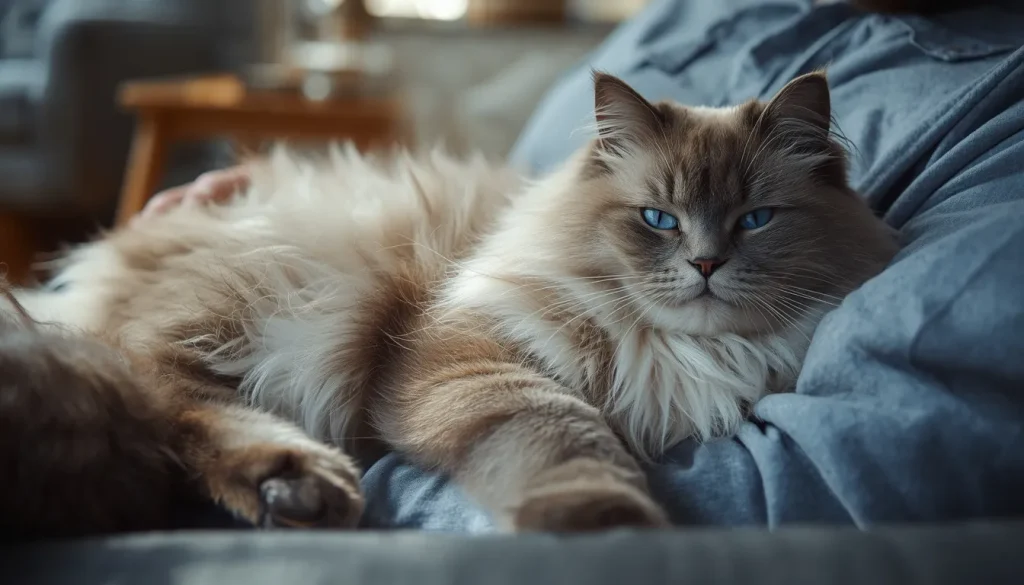
A grey Ragdoll cat is a beautiful combination of soft grey-blue coloring, vivid blue eyes, a silky semi-long coat, and the large, elegant appearance associated with the Ragdoll breed.
The term “grey” can be slightly misleading because formal Ragdoll terminology generally calls this color blue. Understanding that distinction can make it easier to research breeders, patterns, pedigrees, and breed standards.
Beyond appearance, the Ragdoll’s personality is one of its greatest strengths. These cats are generally affectionate, calm, social, and adaptable, although every individual cat has its own temperament.
They can make wonderful companions for families, couples, and individuals who are prepared to provide regular grooming, good nutrition, veterinary care, enrichment, and plenty of companionship.
If you are considering a grey Ragdoll kitten, look beyond coat color. A responsible breeder, good health information, appropriate socialization, and a suitable home environment are far more important than simply finding the prettiest kitten.
With responsible care, a Ragdoll can become a loving and memorable member of your household for many years.